Harnessing AI and ICT for inclusive education for neurodiverse learners
2026-04-20
Check out the ADEDU Guidelines for inclusive digital education platforms
2026-06-03The ADEDU Final Event: What Inclusive Digital Education Looks Like in Practice
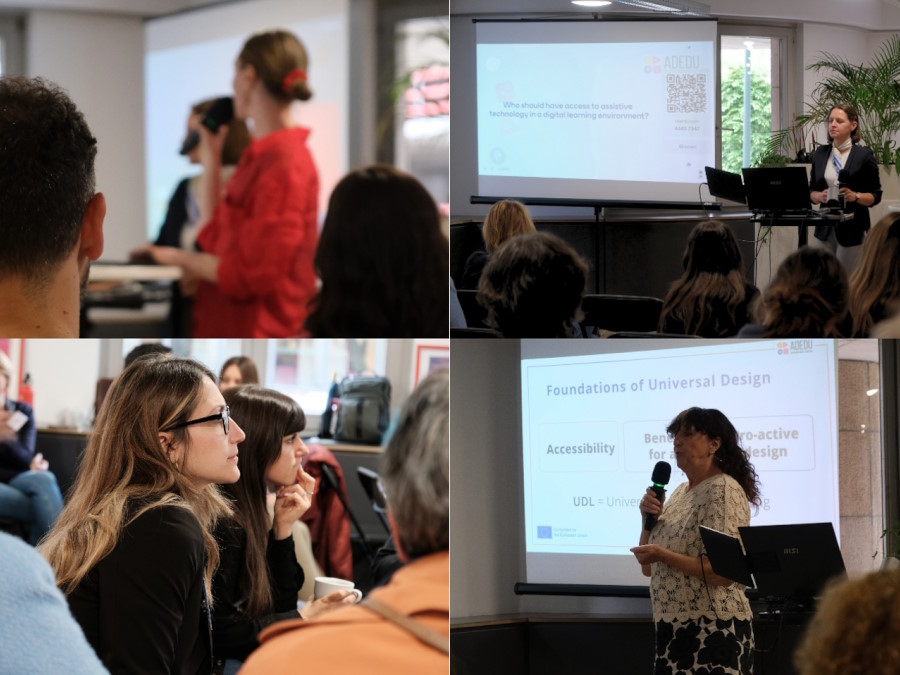
In May, the ADEDU (Accessible Digital EDUcation) project marked the end of two years of work with a final event that brought together educators, trainers and learning professionals to reflect, learn and celebrate.
The afternoon was a reminder that inclusive digital education is something every educator, course designer and learning centre should be thinking about, and acting on.
Starting with a Challenge
The event opened with a quiz. Each question was rooted in real scenarios that educators and course designers are likely to face, from how to handle a learner who struggles to express their understanding in writing, to what to do when a digital course overwhelms rather than teaches. The format gave participants a chance to test their own knowledge but, more importantly, to learn something new through practical, recognisable situations.
Through gamification, each question brought the ADEDU project to life, covering everything from learning disabilities and assistive technology to course design, feedback, digital ethics and what inclusive education really means in practice. And it set the scene perfectly for what came next.
Universal Design for Learning: Back to Basics
The workshop was led by Marleen, an expert in Universal Design for Learning (UDL), and it began somewhere unexpected: architecture.
Universal Design did not start in education. It was coined by architect Ronald Mace in the 1980s to describe designing products and environments that work for as many people as possible, without the need for adaptation. The idea quickly moved beyond buildings. Sloped pavement cuts at road crossings, originally designed for wheelchair users, soon proved useful for parents with pushchairs, cyclists, delivery workers, and travellers with luggage. Automatic doors, created for accessibility, made movement easier for everyone. The same logic has since shaped everything from smartphone voice recognition to adjustable height desks.
In the early 1990s, the Centre for Applied Special Technology (CAST) recognised that the same principles applied to education. Universal Design for Learning was born. Design proactively with every learner in mind and the result works better for all.
The Three Pillars of UDL
UDL is built on three core principles:
- Multiple Means of Representation (The What of Learning) - not every learner takes in information the same way. Some learn best through reading, others through listening or visual content. Offering content in multiple formats means more learners can access what is being taught.
- Multiple Means of Action and Expression (The How of Learning) - if a learner understands the subject but cannot express it in a written essay, that is not a learner problem. It is a format problem. A recorded presentation, a visual project or a portfolio can demonstrate the same level of understanding. What is being assessed does not change. How a learner shows it does.
- Multiple Means of Engagement (The Why of Learning) - not every learner connects with content in the same way. Some need to see why it matters to them personally. Others need more choice in how they work through it. Building in flexibility and relevance from the start is what keeps learners engaged and committed to completing the course.
The key point is that UDL is not about lowering the bar. The learning outcome stays the same for everyone. What changes is how learners can reach it and show it.
Putting It to the Test: The CAST Framework
Participants then moved into breakout groups to put what they had heard into practice. Using the CAST framework, groups examined real digital tools and asked a straightforward but demanding question: do these digital tools support inclusive learning?
The CAST framework encourages educators to look beyond whether a digital tool works technically and ask whether it genuinely supports all learners, those with learning disabilities, those working in a second language, those with limited digital confidence, those who struggle with cognitive overload.
The discussions were revealing. Digital tools that look inclusive on the surface do not always hold up when examined closely. And tools that might seem niche often turn out to have far broader benefits than expected.
The ADEDU Award
The event closed with the ADEDU Awards Ceremony, recognising the organisation that has best demonstrated what inclusive digital education looks like when put into practice.
The award went to the Cyprus Computer Society for their Coding Our Future initiative.
Coding Our Future has reached over 16,000 children across Cyprus, with a clear focus on making sure that no child is excluded due to a lack of resources or access. The initiative provides all necessary equipment: robots, tablets, tools; so that schools and learners who might otherwise be left behind can participate fully. It places a particular emphasis on bridging the gender gap and ensuring that every child, regardless of background or ability, can engage actively.
Teachers involved in the programme are trained in modern, inclusive teaching approaches, in line with the principles at the heart of the ADEDU project. Coding Our Future is a strong example of what the project has been working towards: inclusion not as an afterthought, but as the starting point.
Why This Matters
The ADEDU project was built on a straightforward but important point: accessibility in digital education should not be something you add on at the end. It should be designed in from the start.
That means educators understanding how learning disabilities affect the way people take in and process information. It means applying UDL principles when building courses, not after. It means choosing digital tools thoughtfully, with every learner in mind. It means giving feedback that is genuinely useful, assessing in ways that are fair, and creating online environments where every learner feels safe enough to participate.
The resources developed through ADEDU are all designed to support educators in doing exactly that, not once, but continuously.
Because inclusive digital education is not a box to tick. It is an ongoing commitment to making sure that every learner, regardless of their background, ability or learning difference, can access, participate and succeed.